
Guidelines for Trauma Resuscitation of Pregnant Patients with Estimated Gestational Age > 20 Weeks
Inclusion Criteria for Referral for Possible SSR
- Page HCW OB Trauma Team on Tiger Connect after initial trauma alert
- OB team notifies trauma team leader upon arrival and waits for clearance to enter bay
- Once patient arrives, shift uterus to left side, or bump under right ride to offload IVC
- Fundus above umbilicus indicates >20 weeks GA
- Proceed with normal trauma algorithm and all stabilization procedures
- Primary Survey, chest and pelvis X rays, FAST exam, lines and tubes, OR if indicated
- Recommend Low Titer O+ Whole Blood (LTOWB) in critical patients (risk of alloimmunization low vs. benefits of whole blood). Use pRBC/component therapy in stablepatients
- Once stabilized, OB team cleared to assess fetus
- OB US – May use trauma US machines, or must bring their own
- Fetal monitoring – Tocodynamometer and incubator are in T112B, near blanket warmer
- Pelvic exam
- Pan Scan if indicated
- If emergent C-section required for fetal distress, and maternal FAST negative, may proceed in trauma OR vs. Resus Bay
- C-section cart kept near Trauma OR front desk, incubator in T112B.
- OB nursing must bring all other equipment
- If patient in traumatic arrest, usual ATLS protocol
- Perimortem hysterotomy only to improve resuscitation efforts
- If patient is to remain in Ryder, i.e. trauma admission with fetal monitoring, L&D nurse must remain with patient (trauma nurses don’t do this)
- Only admit to OB if cleared by trauma
Special Considerations for Primary Survey in Pregnancy
Airway:
- Anticipate difficult airway due to edema/weight gain
- RSI meds are safe – Etomidate (0.3mg/kg) and Succinylcholine/Rocuronium (1-1.5mg/kg)
- Greater aspiration risk due to delayed gastric emptying and pressure from gravid uterus
Breathing:
- Place chest tubes higher as diaphragm is displaced cranially
- Maintain Sats>95%, avoid fetal hypoxia
Circulation:
- Shift uterus to left to offload IVC
- Shock may present late due to increased blood volume
- Avoid femoral lines
- Diagnostic peritoneal aspirate should be supra-umbilical
- Increased risk for VTE
Disability
- Seizures – secondary to TBI vs. Pre-eclampsia
- Keppra and TXA are safe
Management of Pregnant Trauma Patients
VTE Prophylaxis
- Heparin and Lovenox both safe in pregnancy
- Ppx dose: Lovenox 30mg BID titrated by anti-Xa levels, for >90kg start at 40mg BID
- Pregnancy results in augmented renal clearance —> may need higher doses
Ionizing Radiation
- Average radiation dose is 10-15 mSv for PanScan, average trauma patient cumulative 24h dose is approx. 20mSv
- <50mSv no increased risk to fetus (National Council on Radiation Protection)
- Rec. consultation w/ attending radiologist for interpretation of CT findings in pregnancy
Antibiotics
- Penicillins, cephalosporins, clindamycin, Flagyl & vancomycin all considered safe
- Tetanus vaccine is safe
Pain medication
- Tylenol is drug of choice
- Short term: morphine, fentanyl, Dilaudid are all safe
- Avoid NSAIDs
Sedation
- Fentanyl, Propofol – low dose
- Avoid benzos and ketamine
Feto-maternal Hemorrhage (to be managed by OB)
- Break in placental barrier, mother Rh- and fetus Rh+ causes alloimmunization and maternal anti-Rh antibodies, harm for future pregnancies
- In major trauma, if fetus Rh+ or unknown, RhoGam 300mcg given, covers 30cc fetal blood
- Kleihauer-Betke (KB) Test indicated to determine if more Rhogam needed (“Hgb F by flowcytometry” in Cerner)
Inclusion Criteria for Referral for Possible SSR
- Page HCW OB Trauma Team on Tiger Connect after initial trauma alert
- OB team notifies trauma team leader upon arrival and waits for clearance to enter bay
- Once patient arrives, shift uterus to left side, or bump under right ride to offload IVC
- Fundus above umbilicus indicates >20 weeks GA
- Proceed with normal trauma algorithm and all stabilization procedures
- Primary Survey, chest and pelvis X rays, FAST exam, lines and tubes, OR if indicated
- Recommend Low Titer O+ Whole Blood (LTOWB) in critical patients (risk of alloimmunization low vs. benefits of whole blood). Use pRBC/component therapy in stablepatients
- Once stabilized, OB team cleared to assess fetus
- OB US – May use trauma US machines, or must bring their own
- Fetal monitoring – Tocodynamometer and incubator are in T112B, near blanket warmer
- Pelvic exam
- Pan Scan if indicated
- If emergent C-section required for fetal distress, and maternal FAST negative, may proceed in trauma OR vs. Resus Bay
- C-section cart kept near Trauma OR front desk, incubator in T112B.
- OB nursing must bring all other equipment
- If patient in traumatic arrest, usual ATLS protocol
- Perimortem hysterotomy only to improve resuscitation efforts
- If patient is to remain in Ryder, i.e. trauma admission with fetal monitoring, L&D nurse must remain with patient (trauma nurses don’t do this)
- Only admit to OB if cleared by trauma
Special Considerations for Primary Survey in Pregnancy
Airway:
- Anticipate difficult airway due to edema/weight gain
- RSI meds are safe – Etomidate (0.3mg/kg) and Succinylcholine/Rocuronium (1-1.5mg/kg)
- Greater aspiration risk due to delayed gastric emptying and pressure from gravid uterus
Breathing:
- Place chest tubes higher as diaphragm is displaced cranially
- Maintain Sats>95%, avoid fetal hypoxia
Circulation:
- Shift uterus to left to offload IVC
- Shock may present late due to increased blood volume
- Avoid femoral lines
- Diagnostic peritoneal aspirate should be supra-umbilical
- Increased risk for VTE
Disability
- Seizures – secondary to TBI vs. Pre-eclampsia
- Keppra and TXA are safe
Management of Pregnant Trauma Patients
VTE Prophylaxis
- Heparin and Lovenox both safe in pregnancy
- Ppx dose: Lovenox 30mg BID titrated by anti-Xa levels, for >90kg start at 40mg BID
- Pregnancy results in augmented renal clearance —> may need higher doses
Ionizing Radiation
- Average radiation dose is 10-15 mSv for PanScan, average trauma patient cumulative 24h dose is approx. 20mSv
- <50mSv no increased risk to fetus (National Council on Radiation Protection)
- Rec. consultation w/ attending radiologist for interpretation of CT findings in pregnancy
Antibiotics
- Penicillins, cephalosporins, clindamycin, Flagyl & vancomycin all considered safe
- Tetanus vaccine is safe
Pain medication
- Tylenol is drug of choice
- Short term: morphine, fentanyl, Dilaudid are all safe
- Avoid NSAIDs
Sedation
- Fentanyl, Propofol – low dose
- Avoid benzos and ketamine
Feto-maternal Hemorrhage (to be managed by OB)
- Break in placental barrier, mother Rh- and fetus Rh+ causes alloimmunization and maternal anti-Rh antibodies, harm for future pregnancies
- In major trauma, if fetus Rh+ or unknown, RhoGam 300mcg given, covers 30cc fetal blood
- Kleihauer-Betke (KB) Test indicated to determine if more Rhogam needed (“Hgb F by flowcytometry” in Cerner)
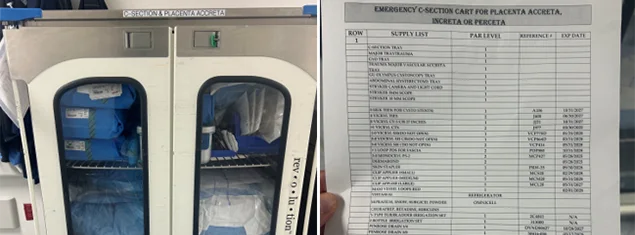
C-section cart located in Trauma OR hallway, to the left of OR Desk
C-Section Cart Supply List
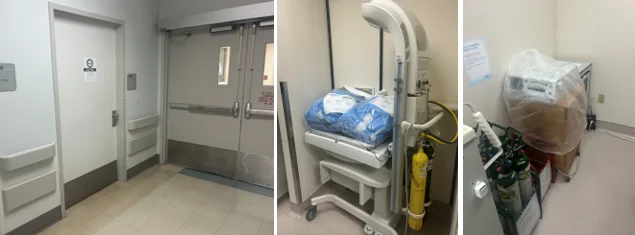
Incubator and tocodynamometer (Toco) located in T112b
(room on left just before exiting trauma resus double doors)
Sources
Clements TW, Van Gent JM, Menon N, et al. Use of Low-Titer O-Positive Whole Blood in Female Trauma Patients: A Literature Review, Qualitative Multidisciplinary Analysis of Risk/Benefit, and Guidelines for Its Use as a Universal Product in Hemorrhagic Shock. J Am Coll Surg. 2024 Mar 1;238(3):347-357.
Monanian G, Greenspan S, Khan Yusufzai N, et al. Anesthetic Management of the Pregnant Patient Undergoing Non-Obstetric Surgery. Medicina (Kaunas). 2025 Apr 10;61(4):698. doi: 10.3390/medicina61040698. PMID: 40282988; PMCID: PMC12028341.
Moirano, J et al. Interventional Radiology and Pregnancy: From Conception through Delivery and Beyond. RadioGraphics 2023 43:8
Sierink JC, Treskes K, Edwards MJ, et al; REACT-2 study group. Immediate total-body CT scanning versus conventional imaging and selective CT scanning in patients with severe trauma (REACT-2): a randomised controlled trial. Lancet. 2016 Aug 13;388(10045):673-83
McCollough CH, Schueler BA, Atwell TD, et al. Radiation exposure and pregnancy: when should we be concerned? Radiographics. 2007 Jul-Aug;27(4):909-17.
Duhl AJ, Paidas MJ, Ural SH, et al; Pregnancy and Thrombosis Working Group. Antithrombotic therapy and pregnancy: consensus report and recommendations for prevention and treatment of venous thromboembolism and adverse pregnancy outcomes. Am J Obstet Gynecol. 2007;197(5):457.e1–457.e21.
Eubanks AA, Deering SH, Thiel LM. Risk assessment and treatment guide for obstetric thromboprophylaxis: comprehensive review of current guidelines. Am J Perinatol. 2019;36(2):130–135.
Lamont MC, McDermott C, Thomson AJ, et al. United Kingdom recommendations for obstetric venous thromboembolism prophylaxis: evidence and rationale. Semin Perinatol. 2019;43(4):222–228.
Babb M, Koren G, Einarson A. Treating pain during pregnancy. Can Fam Physician. 2010 Jan;56(1):25, 27. PMID: 20090076; PMCID: PMC2809170.
Krywko DM, Yarrarapu SNS, Shunkwiler SM. Kleihauer Betke Test. [Updated 2022 Aug 8]. In: StatPearls [Internet]. Treasure Island (FL): StatPearls Publishing; 2025 Jan-. Available from: https://www.ncbi.nlm.nih.gov/books/NBK430876/
Sources
Clements TW, Van Gent JM, Menon N, et al. Use of Low-Titer O-Positive Whole Blood in Female Trauma Patients: A Literature Review, Qualitative Multidisciplinary Analysis of Risk/Benefit, and Guidelines for Its Use as a Universal Product in Hemorrhagic Shock. J Am Coll Surg. 2024 Mar 1;238(3):347-357.
Monanian G, Greenspan S, Khan Yusufzai N, et al. Anesthetic Management of the Pregnant Patient Undergoing Non-Obstetric Surgery. Medicina (Kaunas). 2025 Apr 10;61(4):698. doi: 10.3390/medicina61040698. PMID: 40282988; PMCID: PMC12028341.
Moirano, J et al. Interventional Radiology and Pregnancy: From Conception through Delivery and Beyond. RadioGraphics 2023 43:8
Sierink JC, Treskes K, Edwards MJ, et al; REACT-2 study group. Immediate total-body CT scanning versus conventional imaging and selective CT scanning in patients with severe trauma (REACT-2): a randomised controlled trial. Lancet. 2016 Aug 13;388(10045):673-83
McCollough CH, Schueler BA, Atwell TD, et al. Radiation exposure and pregnancy: when should we be concerned? Radiographics. 2007 Jul-Aug;27(4):909-17.
Duhl AJ, Paidas MJ, Ural SH, et al; Pregnancy and Thrombosis Working Group. Antithrombotic therapy and pregnancy: consensus report and recommendations for prevention and treatment of venous thromboembolism and adverse pregnancy outcomes. Am J Obstet Gynecol. 2007;197(5):457.e1–457.e21.
Eubanks AA, Deering SH, Thiel LM. Risk assessment and treatment guide for obstetric thromboprophylaxis: comprehensive review of current guidelines. Am J Perinatol. 2019;36(2):130–135.
Lamont MC, McDermott C, Thomson AJ, et al. United Kingdom recommendations for obstetric venous thromboembolism prophylaxis: evidence and rationale. Semin Perinatol. 2019;43(4):222–228.
Babb M, Koren G, Einarson A. Treating pain during pregnancy. Can Fam Physician. 2010 Jan;56(1):25, 27. PMID: 20090076; PMCID: PMC2809170.
Krywko DM, Yarrarapu SNS, Shunkwiler SM. Kleihauer Betke Test. [Updated 2022 Aug 8]. In: StatPearls [Internet]. Treasure Island (FL): StatPearls Publishing; 2025 Jan-. Available from: https://www.ncbi.nlm.nih.gov/books/NBK430876/