
G-65 Geriatric Trauma
Criteria
Inclusion
- ≥ 65 years old
- Traumatic Injury
- Injury within 48 hours
Exclusion
- Hospice care
- Injury >48 hours
- Admission criteria is medical
All trauma patients admitted to trauma service over the age of 65 years should be admitted under “Trauma Geriatric”.
Workup
- Consults placed by the ED must be seen expeditiously
- Primary, secondary and tertiary surveys must be completed or confirmed by the trauma team
- Admit to Red / Blue / Green GERI service (do not admit to regular team color)
- Time to admission < 240 mins
- Need for operative intervention does NOT influence decision for Trauma Geri admission
- Hip and lower extremity fracture time to fixation < 24hrs
- Urinalysis should be obtained on all Geri fall patients. Antibiotics if positive.
- Cardiac and medical consultation is NOT required on all Geri patients. Assess baseline level of function, mobility and METS. ECHO is only indicated in selected patients: extensive cardiac history or presence of a murmur. Fellow or senior resident should confer with Anesthesia attending directly, whether ECHO is necessary prior to surgery.
- Always consider mechanism of injury and maintain high index of suspicion for elder abuse. A report must be filed ASAP, if there is any concern.
Definition
- Isolated orthopedic injuries include those injuries confined to the extremities that consist primarily of bone and joint involvement. This includes both operative and non-operative pathologies.
- Soft tissue injury associated to fracture or isolated ligament/tendon/cartilage does not preclude orthopedic admission.
Criteria
Inclusion
- ≥ 65 years old
- Traumatic Injury
- Injury within 48 hours
Exclusion
- Hospice care
- Injury >48 hours
- Admission criteria is medical
All trauma patients admitted to trauma service over the age of 65 years should be admitted under “Trauma Geriatric”.
Workup
- Consults placed by the ED must be seen expeditiously
- Primary, secondary and tertiary surveys must be completed or confirmed by the trauma team
- Admit to Red / Blue / Green GERI service (do not admit to regular team color)
- Time to admission < 240 mins
- Need for operative intervention does NOT influence decision for Trauma Geri admission
- Hip and lower extremity fracture time to fixation < 24hrs
- Urinalysis should be obtained on all Geri fall patients. Antibiotics if positive.
- Cardiac and medical consultation is NOT required on all Geri patients. Assess baseline level of function, mobility and METS. ECHO is only indicated in selected patients: extensive cardiac history or presence of a murmur. Fellow or senior resident should confer with Anesthesia attending directly, whether ECHO is necessary prior to surgery.
- Always consider mechanism of injury and maintain high index of suspicion for elder abuse. A report must be filed ASAP, if there is any concern.
Definition
- Isolated orthopedic injuries include those injuries confined to the extremities that consist primarily of bone and joint involvement. This includes both operative and non-operative pathologies.
- Soft tissue injury associated to fracture or isolated ligament/tendon/cartilage does not preclude orthopedic admission.
Medications
- Ofirmiv will be first analgesic medication in Resus/ED
- Judicious use of opioids and sedatives utilizing narcotics only with gentle escalation, as necessary. Suggested starting doses for geriatric patients:
- Oxycodone 2.5mg
- Morphine 2 mg
- Fentanyl 25 mcg
- Dilaudid 0.5 mg
- Tramadol 25 mg
- * Gabapentin 100mg *. Controversial and group discordance about its use. Special circumstances only.
- Olanzapine 2.5 mg
- Melatonin 3 mg
- DVT ppx: Lovenox 30 mg BID or heparin 5000units TID, if renally impaired
- Sz ppx: Keppra 500mg BID
- Remember to dose medications for reduced GFR
Level Of Care
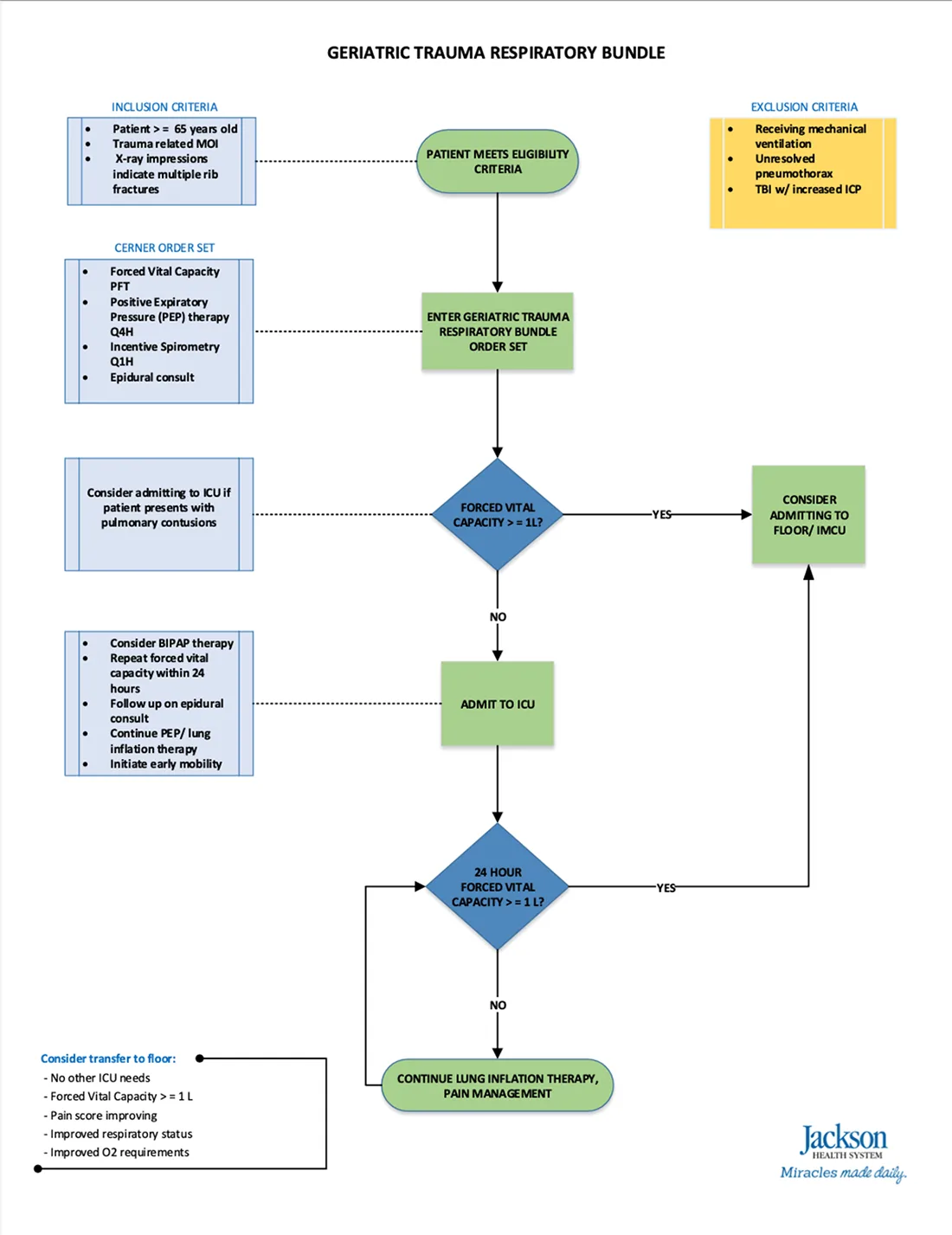
- If rib fractures present, refer to Rib Fracture Protocol above plus Regional Anesthesia consult
- Med/Surg patients will be admitted to Trauma 4A
- Isolated TBI should be admitted to NRS
- Post-operative patients will be admitted to TICU for perioperative cardiac monitoring, unless deemed unnecessary by the Trauma Attending, ONLY.
Ancillary
- All Geri patients to be seen and assessed by PT/OT within 24hrs of admission
- Social Work assessment within 24hrs with projected disposition and identification of potential barriers to dispo.
Trauma Geriatric Postop Process for ICU admission overflow
- All patients over 65 years old will be evaluated in the ICU post operatively.
- The level of care can be changed at any time once the Trauma attending decides they are appropriate for another level of care.
- If the TICU and SICU are full then the patient is to be placed in the PATU to be evaluated by the Trauma attending with the possibility of 3 pathways.
- The patient is be determined safe for transfer to another level of care
- The patient is determined to be critically ill and remains in place until a bed can be made in TICU or SICU
- The patient requires ongoing monitoring but is determined to be safe to be transferred to an ICU bed on Trauma 3a
*Sign out from Trauma Team to Trauma 3a NP must occur before transfer.*
-
-
- Only in beds 392 and 394 with nursing ration of 1:2
- Cared for by Trauma 3a NP with first call to Trauma team for escalation
- * The goal is to send all patients to TICU on second floor but will use overflow if needed
-
Medications
- Ofirmiv will be first analgesic medication in Resus/ED
- Judicious use of opioids and sedatives utilizing narcotics only with gentle escalation, as necessary. Suggested starting doses for geriatric patients:
- Oxycodone 2.5mg
- Morphine 2 mg
- Fentanyl 25 mcg
- Dilaudid 0.5 mg
- Tramadol 25 mg
- * Gabapentin 100mg *. Controversial and group discordance about its use. Special circumstances only.
- Olanzapine 2.5 mg
- Melatonin 3 mg
- DVT ppx: Lovenox 30 mg BID or heparin 5000units TID, if renally impaired
- Sz ppx: Keppra 500mg BID
- Remember to dose medications for reduced GFR
Level Of Care
- If rib fractures present, refer to Rib Fracture Protocol above plus Regional Anesthesia consult
- Med/Surg patients will be admitted to Trauma 4A
- Isolated TBI should be admitted to NRS
- Post-operative patients will be admitted to TICU for perioperative cardiac monitoring, unless deemed unnecessary by the Trauma Attending, ONLY.
Ancillary
- All Geri patients to be seen and assessed by PT/OT within 24hrs of admission
- Social Work assessment within 24hrs with projected disposition and identification of potential barriers to dispo.
Trauma Geriatric Postop Process for ICU admission overflow
- All patients over 65 years old will be evaluated in the ICU post operatively.
- The level of care can be changed at any time once the Trauma attending decides they are appropriate for another level of care.
- If the TICU and SICU are full then the patient is to be placed in the PATU to be evaluated by the Trauma attending with the possibility of 3 pathways.
- The patient is be determined safe for transfer to another level of care
- The patient is determined to be critically ill and remains in place until a bed can be made in TICU or SICU
- The patient requires ongoing monitoring but is determined to be safe to be transferred to an ICU bed on Trauma 3a
*Sign out from Trauma Team to Trauma 3a NP must occur before transfer.*
-
-
- Only in beds 392 and 394 with nursing ration of 1:2
- Cared for by Trauma 3a NP with first call to Trauma team for escalation
- * The goal is to send all patients to TICU on second floor but will use overflow if needed
-